
Do you still move if storms are forecast?
NSW SES incidents, last storm season
Last storm season, fallen trees and damaged roofs made up roughly 58% of the NSW SES's work, by our estimate. Here is the working. The SES says it responded to more than 23,416 incidents last storm season, including roughly 7,000 fallen trees and more than 6,500 leaking or damaged roofs. Together that is about 13,500, or around 58% of 23,416.
Those are the two failures that hurt a moving day most. One is a tree across the street the truck needs. The other is water through a roof onto a room of packed boxes.
Floods matter too, but there were fewer of them. A NSW Government release at the season's close counted more than 1,500 flood related incidents. Fallen trees came out several times ahead. That is our estimate, from about 7,000 against more than 1,500.
So do you still move? A forecast alone rarely settles it. The warning level for your area does, and so does the sky above your driveway. Hunters Hill Removals' short answer is below. The next section explains it.
- Advice: keep preparing and talk to your removalist early.
- Watch and Act, or a Bureau severe thunderstorm warning for your area: ask about rescheduling.
- Emergency Warning: shelter, and the move waits.
- No warning at all: treat the natural signs as one, because warnings don't always come.
The season is long. NSW Storm Season falls between September and April, though major storms can happen at any time of the year. A spring or summer moving date in Sydney sits inside it.
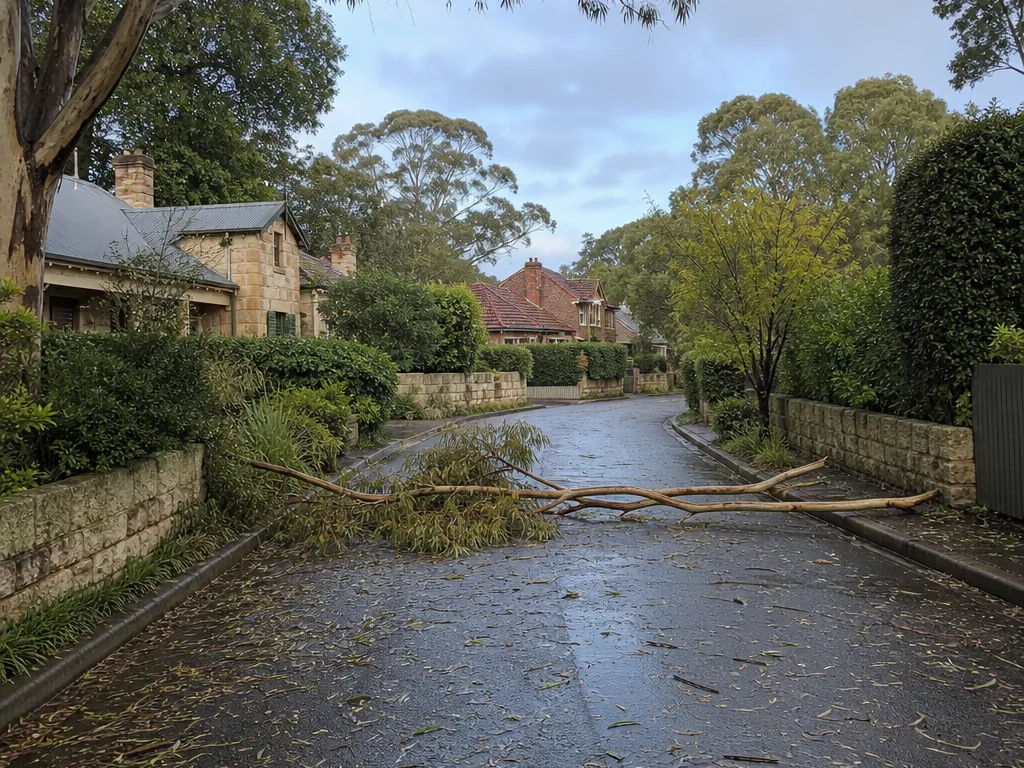
Should I move house in a storm? Read the warning, then the sky
-
Advice: prepare now and monitor conditions
Keep preparing; talk to your removalist early about how the morning call will be made
-
Watch and Act: stay indoors and avoid the area
or
Bureau Severe Thunderstorm Warning for your area
Ask your removalist about rescheduling
-
Emergency Warning: seek shelter now
Shelter. No loading, no driving
You may not get an official warning. Natural signs: heavy cloud, darkening skies, increasing winds, thunder, lightning, heavy rain
Stop loading, get people and goods under cover
The advice column is Hunters Hill Removals' suggestion; the warning wording is the SES's.
The SES issues storm warnings at three levels of the Australian Warning System. Advice means prepare now and monitor conditions. Watch and Act means stay indoors and avoid the area. Emergency Warning means seek shelter now. The Bureau of Meteorology separately issues Severe Weather and Severe Thunderstorm Warnings.
Here is how we would read that ladder for a moving day. It is our advice, not an SES rule.
Advice. Keep the date and keep preparing. Ring your removalist a day or two out and agree how the call will be made on the morning: who rings whom, and by what time.
Watch and Act, or a Bureau Severe Thunderstorm Warning for your area. Ask your removalist about rescheduling. "Stay indoors" and carrying a sideboard down a wet driveway don't fit in the same afternoon.
Emergency Warning. Seek shelter. Nobody should be loading or driving a truck.
No warning, but the sky is turning. The SES is plain that you may not get an official warning. The signs to watch are heavy cloud, darkening skies, increasing winds, thunder, lightning and heavy rain. If they arrive mid-load, stop. Get people under cover first, then the goods.
Why plan for the morning call rather than decide a week out? The Bureau says it is "much harder to impossible" to forecast exactly where and when thunderstorms form. The SES says storms "can happen quickly and without much warning". East of the Divide, the Bureau's Max Gonzalez notes the spring signal is variable because of warm Tasman Sea temperatures. He adds that coastal troughs and thunderstorms can interrupt a dry period with heavy rain, damaging winds, large hail and flash flooding. A dry week before your move tells you little about the day itself.
How a delay is handled, and what it costs, is set by your contract. That is why the contract section further down is worth reading before you sign.
What makes a thunderstorm severe?
| Level | Thresholds |
|---|---|
| Severe |
|
| Very dangerous |
|
| Most severe thunderstorms happen between September and March. | |
The word "severe" in a warning has a definition. The Bureau calls a thunderstorm severe if it produces any one of these: hail of 2 cm or more, wind gusts of 90 km/h or more, tornadoes, or heavy rain that may cause flash flooding. "Very dangerous" means hail of 5 cm or more, gusts of 125 km/h or more, or intense rainfall.
Most severe thunderstorms happen between September and March, which overlaps the busiest stretch of the moving year.
Picture a 90 km/h gust on a moving day. The truck's ramp is down. The front door is propped open. Half the outdoor setting is standing on the driveway waiting its turn. The SES warns that unsecured trampolines and outdoor furniture can become "lethal projectiles" in strong winds. On a moving day, more of your furniture is outdoors than on any other day of the year.
Moving house in the rain: protecting the truck day
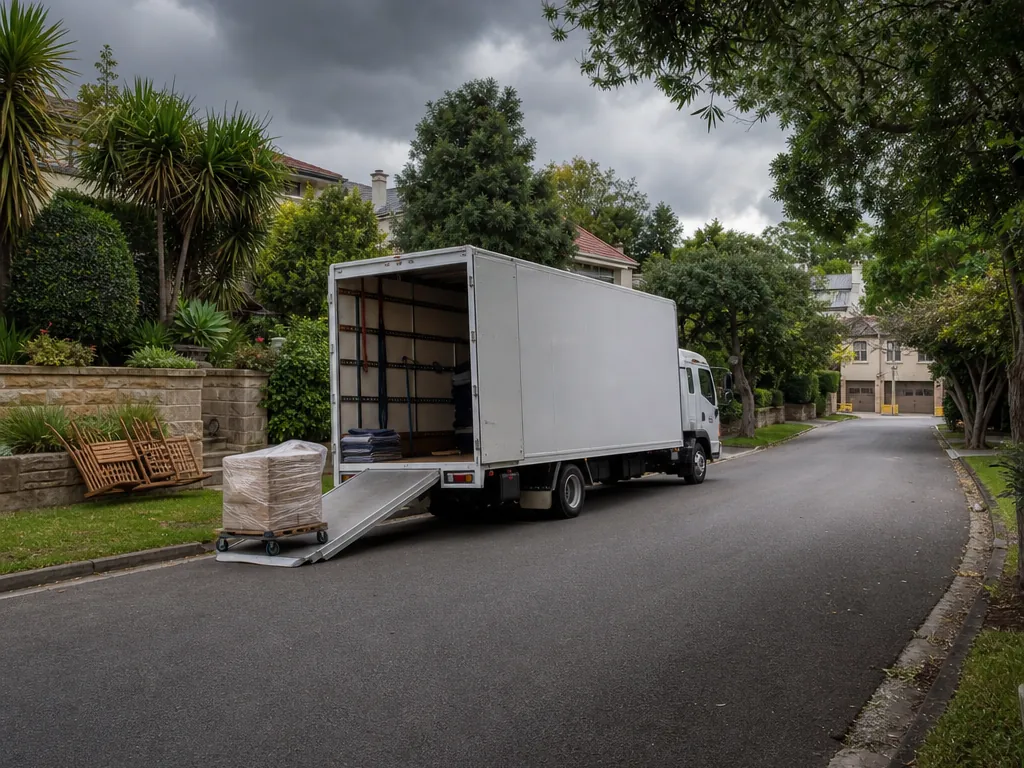
Night before
Morning of
Most storm-season moves go ahead in ordinary weather. The point of preparing is that the bad day doesn't catch you with everything on the kerb.
The night before. If storms are forecast, the Bureau's advice is to watch the website and radar. The SES urges the Hazards Near Me app with a watch zone set, and the BOM Weather app. On a moving day you have two addresses, so set a watch zone on each.
At both homes, secure or put away loose outdoor items. Write down the numbers you might need with wet hands: your removalist, the fallen-lines number in the next section, and 000.
The morning of. Check warnings and radar again before the truck leaves. Check Live Traffic NSW for road closures along the route. If a storm does hit, the SES says to travel only if essential and turn around at flooded roads.
The route and the kerb. On the Hunters Hill peninsula, a closed road or a branch across the one kerb that fits a truck changes the whole day. Our guide to the Three Bridges covers getting a truck onto the peninsula. Where the Truck Stands covers access street by street.
Where should the truck park, and what if a line comes down?
The SES advice for any vehicle in a storm is to park vehicles away from trees and flood-prone areas. A loaded truck is a vehicle with your whole household inside it. The kerb under the biggest street tree is the spot to avoid.
Trees and powerlines often come down together. The rule here has no exceptions worth testing:
- Always assume fallen powerlines are live and stay at least 8 metres (2 car lengths) away.
- Trees across powerlines may be electrified, and you should not try to remove them.
Where Ausgrid is your network, it takes fallen-line reports on 13 13 88 (24 hours). Call 000 if life is at risk.
For a move, a line down across your street means waiting or finding another way in. Nobody, however keen to finish, should drag a branch off a wire.
Transit insurance when moving: who covers your goods if a storm hits?
| Cover | What the source says | Ask |
|---|---|---|
| A removalist's own insurance |
Source: NSW Fair Trading | Ask what is and isn't covered |
| AFRA member insurance |
Source: AFRA | Ask whether they are AFRA-accredited |
| Transit insurance |
Source: NSW Fair Trading, AFRA | Ask for the Product Disclosure Statement and Financial Services Guide, and check what the PDS says about weather |
A common mistake is assuming the removalist's insurance automatically covers your goods: NSW Fair Trading says removalists are not required by law to insure your property during a move, and transit cover is a separate product.
Fair Trading adds that most only carry insurance covering their vehicle in an accident, and it recommends getting your own insurance.
Transit cover insures goods while they are packed, moved and stored. Extending it to storage is a separate premium. That matters if a storm pushes your goods into a few nights in storage.
The Australian Furniture Removers Association says its members must hold public liability, third party property, motor vehicle and carrier's legal liability insurance. It also says "not all damages and breakages are the liability of the removalist".
A removalist selling transit insurance should be able to give you a Product Disclosure Statement and a Financial Services Guide. Ask for both. Whether weather damage is covered depends on the policy, so check your policy and its PDS rather than assuming either way.
If something is damaged, the SES says to contact your insurer as soon as possible to lodge a claim.
For the wider picture on accreditation and quotes, see our guide to comparing removalists.
What should the contract say if weather delays the move?
Your consumer guarantees
- Services provided with due care or skill, taking all necessary steps to avoid loss and damage
- Where no time is set, completed in a reasonable time, which can depend on busy periods and public holidays
Source: NSW Fair Trading
A storm that stops the truck turns a contract from paperwork into the plan. Fair Trading says the contract should show the inventory, the dates and times, how payment is made, and any extra costs for storage if there are delays. The last item is the one a weather delay sets off. Read it before storm season, not on the morning.
The Australian Consumer Law also applies. Removalist services must be provided with due care or skill, "taking all necessary steps to avoid loss and damage".
Where no time is set, they must be completed in a reasonable time, and what counts as reasonable can depend on busy periods and public holidays. Storm season runs straight through Christmas and the January holidays. A firm date and time written into the contract is worth more then than at any other point in the year.
Storm-season moving at a glance
Last storm season
- More than 23,416 SES incidents
- Roughly 7,000 fallen trees
- More than 6,500 leaking or damaged roofs
Source: NSW SES
Severe thunderstorm
- Any of hail 2 cm or more, gusts 90 km/h or more, tornadoes, or heavy rain that may cause flash flooding
Source: Bureau of Meteorology
Fallen powerlines
- Assume live
- Stay at least 8 metres (2 car lengths) away
- Ausgrid 13 13 88, 000 if life is at risk
Goods cover
- Removalist insurance often covers only the vehicle
- Transit insurance is separate
- Ask for the PDS and FSG
Source: NSW Fair Trading, AFRA
Five things to keep from this page: the season, last season's numbers, what "severe" means, the 8 metre rule, and who covers your goods. The card above puts them in one place, each with its source.
Your next step: put the weather plan in the booking
If your move falls between now and April, raise the weather before you sign, not on the morning of the move.
Request a callback from Hunters Hill Removals and bring three questions:
- How will the go or no-go call be made on the day?
- What does the contract say about delays and storage costs?
- What insurance covers your goods while they are packed, moved and stored?
Settle those three, and a forecast becomes something you planned for rather than something you're scrambling around.
Sources
- https://www.ses.nsw.gov.au/stormseason
- https://www.nsw.gov.au/ministerial-releases/new-flood-rescue-vehicles
- https://www.ses.nsw.gov.au/news/el-nino-sharpens-focus-storm-preparedness-across-nsw
- https://www.bom.gov.au/resources/learn-and-explore/severe-weather-knowledge-centre/thunderstorms
- https://www.ses.nsw.gov.au/during-emergency/during-storm
- https://www.ausgrid.com.au/outages-and-issues/in-an-emergency/fallen-powerlines
- https://www.nsw.gov.au/legal-and-justice/consumer-rights-and-protection/be-a-smart-consumer/choosing-a-removalist
- https://afra.com.au/moving/moving-tips/moving-insurance/
Pictures in this guide are illustrations, not photos of our jobs.