
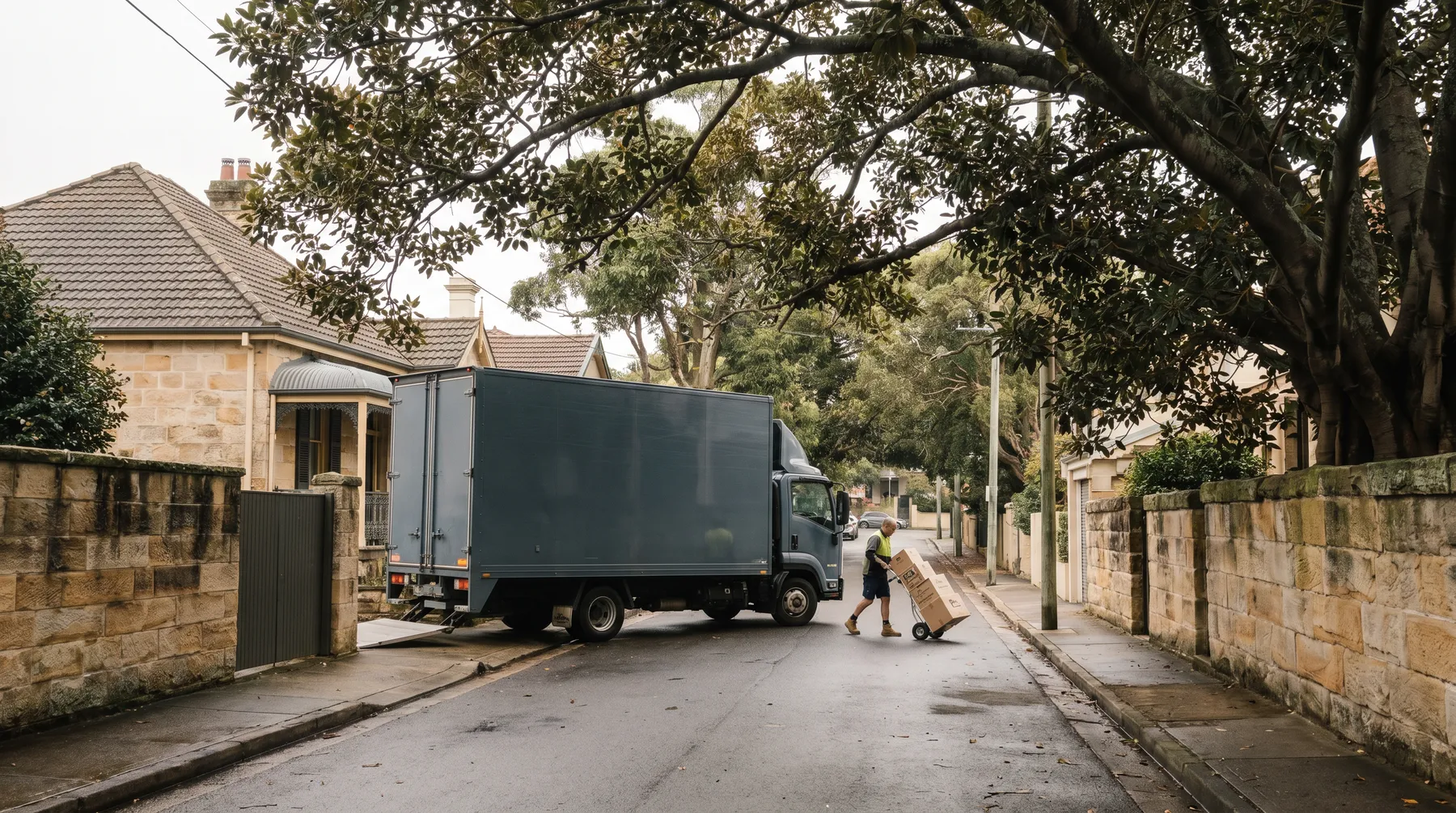
How we read a street
Four questions, asked in order: can the truck legally stand within a fair carry of the door; will it leave room for the street to keep working around it; what is overhead, since the fig canopy that makes these streets beautiful also sets a hard height limit; and where does the carry actually run once the doors open. Everything below is those four questions, pre-answered as far as honesty allows.
The spine roads
- Gladesville Road. The suburb's main working street and its densest address run. Standing is about timing and signage here: we check the controls for the exact block, and where the shops cluster we prefer an early start before the parking fills.
- Woolwich Road. The spine to the point. Long, mostly workable, but it is also the only way through, so we stand off it wherever a side street offers a fair carry, and never leave the truck where it makes the road one-way in practice.
- Ryde Road and Pittwater Road. The north-west connectors in from Fig Tree Bridge: approach roads more than standing roads. Their job is to deliver the truck to the quieter street where the house actually is.
The Village and the mid peninsula
- Alexandra Street. One of the suburb's biggest streets by addresses, and the classic Hunters Hill mix: parked cars both sides, mature trees, houses set well back. The standing spot is usually obvious once walked, and wrong if guessed from a map.
- Ferry Street and the fig-arched stretches. The prettiest runs on the peninsula and the ones where height matters as much as width. On streets arched by figs we check the canopy against the truck before committing the route, and a smaller vehicle plus a short shuttle is sometimes the smart answer.
- Joubert Street, Madeline Street, Mary Street. Established, settled, tighter near the water end. The long garden approaches begin here: the truck stands where it can, and the carry is planned like part of the job, because it is.
The ridge and the French avenues
- Passy Avenue, St Malo Avenue, Le Vesinet Drive, Croissy Avenue. The street signs remember the suburb's French founders, and the blocks remember their gardens: generous, green and often a genuine walk from the kerb to the door. We crew for the carry rather than pretending the garden is shorter than it is.
- The waterfront dead-ends. Short streets that fall to the rivers rarely have turning room for a big pantech at the bottom. The plan is usually to stand high, carry down, and keep the trolley work on the flattest line the block offers.
When Council is part of the plan
Some standing arrangements on controlled streets are Council's call, not ours or yours. Where that applies we handle the arrangement as part of the booking, in advance, through Hunter's Hill Council. What we do not do is gamble your move day on an untested spot and call the fine a surprise expense.
The short version
Every street here has a right answer, and almost none of them are visible from a quoting desk in another suburb. Tell the Approach Plan your pocket and it will sketch the likely shape; the walk-through makes it certain.