
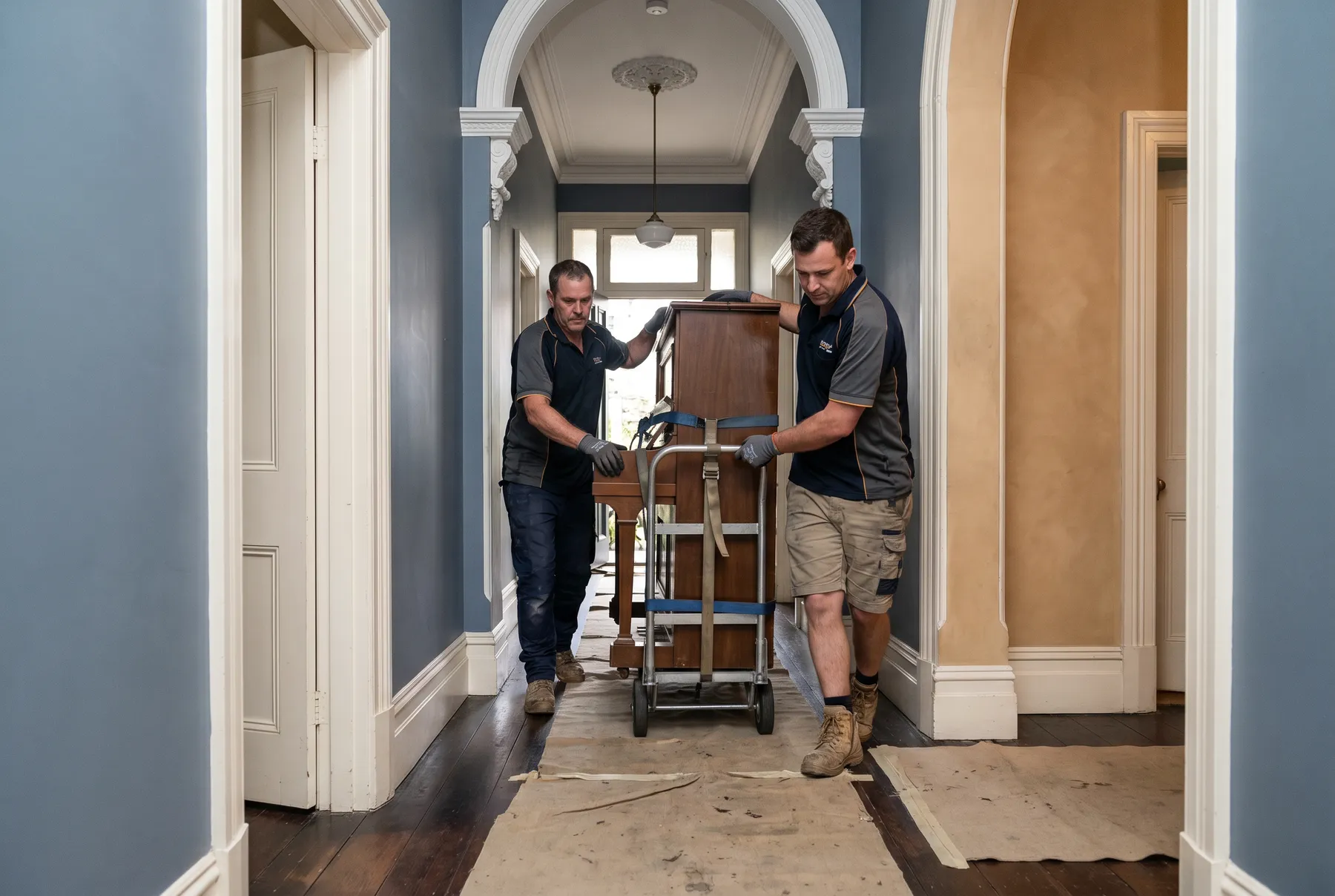
First, the honest facts about upright pianos
An upright is heavy at the top and shallow at the base, which means it tips before it slides and it punishes improvisation. It is also, in nearly every case, narrower than the hallway it lives in, which means the move is a geometry problem long before it is a strength problem. Geometry problems are solved on paper, so that is where we start.
The sequence
Measure the piano, then the route
Height, width, depth of the instrument; width of the hallway, the doorway, the verandah turn; height of the step down. Ten minutes with a tape settles whether this is a straightforward roll or a planned pivot.
Dress the route
Runners the full length, board over the threshold, pads tied at the doorway and any turn tighter than easy. The piano's own corners get wrapped too; the house and the instrument protect each other.
Trolley, straps, and the right two people
The piano rides a proper piano trolley, strapped, with a mover at each end who has done exactly this before. Down the hallway it moves at walking pace with pauses at each mark on the plan.
The step is its own event
Verandah steps and the front threshold get boards or ramps, never a bounce. If there are more than a couple of steps, the plan says so in advance and the crew is sized for it.
Into the truck, against the headboard
The piano loads first or near it, strapped upright against the truck's headboard where the ride is calmest, and nothing travels leaning on it.
When the door is not the answer
Occasionally a period doorway, a hairpin hallway or a sunken garden makes the front door the wrong route, and the honest answer is a window, a balcony or, rarely, a specialist crane hire. We will tell you that at the planning stage, with the options and their real trade-offs, rather than discovering it with the piano half-committed. The one thing we will not do is force it: a brave piano move is just a damage report with momentum.
Grands, pianolas, organs
A grand comes apart further than most owners expect, legs, lyre, sometimes the action, and travels on its side on a skid board built for the job. A pianola is an upright with extra weight in awkward places. A pipe organ is a conversation with a specialist, and we will say so. In every case the rule holds: name the instrument on the enquiry and the plan includes it from the first callback.
What it costs
A piano inside a house move is crewed within the move, it is not a bolt-on fee. On its own, a local piano relocation is usually a two or three mover job at the same published hourly rates as everything else: see the rates page. Stairs, distance and the instrument itself decide the hours; the callback settles them before you commit.